
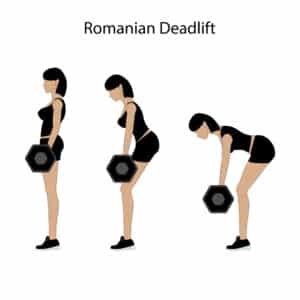
The Romanian deadlift is one of the most underrated, misunderstood, and under-utilized strength moves in all of resistance training. Yet the people who DO master the Romanian deadlift end up gaining advantages most lifters chase for years: stronger hamstrings, better posture, better hip hinge mechanics, stronger glutes, and increased ability to move heavy loads in real-world life — without hurting their back. It is part strength training, part mobility, and part long-term bulletproofing.
Below are seven clear reasons the Romanian deadlift matters — especially for anyone who wants real-world strength that lasts.
1) It strengthens the posterior chain
Most people spend most of their day sitting. That deactivates glutes, shortens hip flexors, and makes hamstrings weaker. The Romanian deadlift reverses that. It builds the powerful back-side muscles that drive sprinting, jumping, walking hills, lifting groceries, shoveling soil, and even moving furniture.
Posterior chain =
- glutes
- hamstrings
- spinal erectors
- lower traps
-
mid-back stabilizers
No strength program is complete without posterior chain.
2) It improves hip hinge mechanics
A strong hinge is the foundation of long-term back resiliency. The Romanian deadlift teaches you to push hips backward — not bend the spine forward.
This saves your back later.
Good hinge → strong hips doing the work
Bad hinge → low back doing the work
One makes you stronger. One gets you hurt.
3) The Romanian deadlift makes you better at the regular deadlift
World-class deadlifters use Romanian deadlifts as accessory work.
Why?
Because the Romanian deadlift strengthens the weak link in most deadlifts — the bottom half.
Strong hamstrings = better lockout + more efficient bar path.
4) Romanian deadlift develops grip strength
A surprising hidden advantage: your hands MUST hold weight the entire time — and there’s no “rest moment” at the floor between reps like with a conventional deadlift.
This means more time under tension for forearms.
And time under tension = strength adaptation.
5) It reduces hamstring injury risk
Not just gym injuries — sprinting, change-of-direction, and recreational sport injuries.
The Romanian deadlift applies eccentric stress (lengthening under load) to hamstrings — and eccentric strength is the #1 predictor of reduced hamstring strain risk.
Soccer, basketball, track, and rugby athletes all benefit.
6) It builds functional posture
The anterior chain (front side) constantly tightens through sitting.
The posterior chain (back side) becomes weak.
This imbalance is one of the root drivers of:
- swayback posture
- forward head posture
- rounded shoulders
- low back tightness
The Romanian deadlift literally pulls posture back into balance.
Hips go back. Chest stays tall. Spine stays neutral.
7) It is one of the highest ROI strength movements
It produces more strength per minute than most lifts because it trains huge muscle groups at once.
It is “value dense.”
And you can do variations based on your dumbbells, trap bar, barbell, smith machine, and kettlebell
Final form cues to keep in mind
- push hips BACK first
- feel stretch in hamstrings BEFORE lowering further
- keep bar close to legs
- knee bend slight — not squat
- spine neutral — chest proud — chin neutral
Common mistakes to avoid
- rounding lower back to “get deeper”
- bending knees too much (turns into squat)
- pushing weight too far away from body
- looking up excessively (neck compression)
Bottom line
The Romanian deadlift teaches strength that transfers to life. It bulletproofs hamstrings, strengthens glutes, reinforces posture, protects spine mechanics, and maximizes the hinge. Every training plan is more complete when this underrated movement becomes a staple.
Reference
Behm DG, et al. “Eccentric training and hamstring injury prevention.” Journal of Strength and Conditioning Research. 2021. DOI:10.1519/JSC.0000000000003678.