
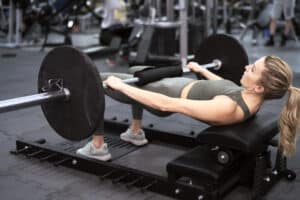
Hip thrust remains one of the most practical posterior-chain builders because it focuses tension directly into hip extension. The hip thrust helps lifters feel glute contraction clearly, and that sensory awareness helps carry over into other movement patterns. A major reason people enjoy this style of lower-body work is the simplicity of setup paired with clear, measurable output. Strength increases feel obvious, and that reinforces motivation. The hip thrust aligns the load nearly perfectly with the anatomical purpose of the glutes — generating hip extension power.
As more people train from home or in smaller gyms, this approach offers a repeatable pattern that encourages the body to hinge well while still controlling spinal position. The hip thrust becomes a skill, not just an exercise — and skill is what creates sustainable results. This article presents six positive benefits, technique notes, and the mindset patterns that help consistency feel natural rather than forced.
Hip thrust for a purpose-driven posterior chain strategy
Posterior chain strength is more than aesthetics. It’s also how your hips create stable torque while your spine remains calm. When the pelvis and hips drive the lift, the pattern strengthens the interface between intent and muscle output. Glute activation maps into the nervous system as controlled power, not brute strain. The hip thrust lets your body rehearse this pattern under tension in a predictable arc of motion.
1) Improved glute hypertrophy stimulus
Posterior-dominant loading reveals how much growth capacity the hips have when they are allowed to take center stage. Training volume feels productive, not punishing. The hip thrust naturally guides tension to the back of the body.
2) Reduced low-back interference
The horizontal torso position minimizes lumbar irritation and limits excessive spinal shear. For many people, this is the key that unlocks progressive loading without fear of “tight low back days.” When people feel safe, they stay consistent.
3) Reliable power transfer
Athletic movements like sprinting begin with powerful push-downs into the ground. Horizontal force patterns build acceleration. This is why the hip thrust shows up in many athletic programs.
4) Comfortable progression
Simple load progression — slow eccentrics, paused top holds — create visible improvement. You don’t need complicated programming models. You only need clear intent per set.
5) Natural postural reinforcement
The top contraction teaches what using glutes actually feels like. This motor learning is one of the most underestimated training gifts available to a general-population lifter.
6) Consistency and long-term identity
If progress is satisfying, identity forms. When identity forms, training becomes habit rather than task. The hip thrust helps reward lifters often enough to maintain long cycles of steady growth.
Technique cues that matter more than load
Upper back anchored. Ribs quiet. Pelvis slightly tucked. Drive knees outward as hips lift upward. Hold a deliberate top squeeze — full hip extension without lumbar extension. Controlled tempo (especially the lowering phase) keeps tension where it matters. Most general strength work improves nicely in the 8–15 rep range with moderate effort and clean execution.
Why consistency matters more than novelty
Training that is easy to repeat — mentally and physically — is training that creates long-term adaptation. Lower spinal stress budgets keep recovery costs reasonable. Posterior chain development shapes how you walk, stand, climb stairs, and carry yourself daily. Because results stack gradually, this movement gives you permission to grow patiently instead of rushing.
Simple. Repeatable. Rewarding. That combination is exactly why this pattern has become a staple for so many.
References:
• https://pubmed.ncbi.nlm.nih.gov/30167670/